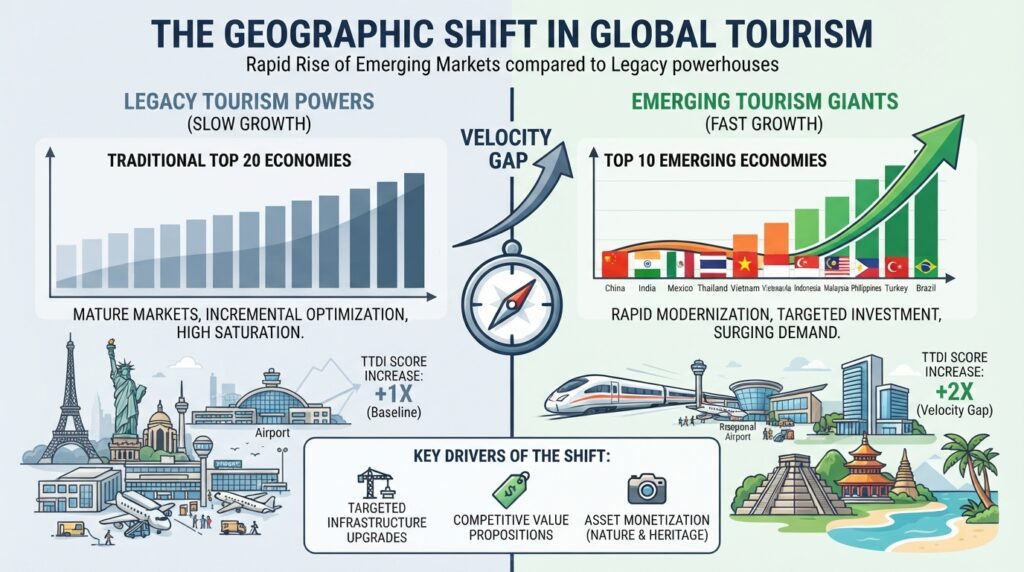
While legacy travel powerhouses in North America and Western Europe continue to command the upper tiers of global tourism rankings, a fundamental geographic shift is rewriting the industry’s balance of power. According to the World Economic Forum’s (WEF) Travel & Tourism Development Index (TTDI), a core group of major emerging economies is closing the gap at an unprecedented rate.
As highlighted in Section 4.3 of the TTDI report, the world’s 10 largest emerging tourism markets—including major players such as China, India, Mexico, Thailand, Vietnam, Indonesia, Malaysia, the Philippines, Turkey, and Brazil—have improved their index scores more than twice as fast as the overall Top 20 economies since 2019.
For global investors, hotel chains, and destination development boards, this velocity gap signals an urgent mandate: the next era of high-yield tourism growth will be defined less by legacy dominance and more by the rapid modernization of the developing world.
1. The Growth Velocity Gap: Accelerating Past the Baseline
For decades, high-income advanced economies held a structural monopoly on tourism performance, backed by mature aviation grids, dense commercial centers, and deep-pocketed capital investments. However, the post-pandemic recovery cycle has acted as a powerful compressor of time and distance.
While top-tier destinations focus on incremental optimization or grapple with saturation, emerging markets are benefiting from a compounding convergence of deliberate policy reforms, targeted infrastructure injections, and surging global demand for authentic experiences. The data reveals that these 10 major emerging economies are not merely participating in the post-pandemic recovery—they are outpacing traditional heavyweights at double the speed, fundamentally reshaping global tourism competitiveness.
2. Asia-Pacific: The Epicenter of Momentum
The vanguard of this transformation is anchored firmly in the Asia-Pacific region, which has emerged as the fastest-improving global hub.
- The Post-Pandemic Catch-Up: Benefiting from a delayed but explosive reopening timeline compared to the West, developing markets across South and Southeast Asia have systematically modernized their underlying tourism frameworks.
- Global Outperformers: Developing economies in the region account for seven out of the 10 fastest-improving performers globally in the index. Standout examples include India—which climbed nine positions to rank 31st globally, propelled by rich cultural resources, robust cost-competitiveness, and expanding business-travel infrastructure—alongside strong surges across Southeast Asian markets.
- Global Diversification: Beyond Asia, emerging giants like Mexico and Brazil continue to capitalize on shifting consumer preferences, leveraging rich natural assets, competitive price points, and expanding hospitality pipelines.
3. What is Fueling the Surge?
The rapid ascent of these emerging heavyweights is driven by targeted structural improvements across several core TTDI pillars:
- Targeted Infrastructure Upgrades: Governments and private investors are aggressively channeling capital into transport networks, regional airports, and digital connectivity, bridging the structural gaps that once isolated secondary and tertiary regions.
- Competitive Value Propositions: While traditional European and North American destinations battle a severe price-competitiveness crisis—with travel costs outpacing general inflation in three-quarters of economies—many emerging markets offer superior value-for-money, capturing cost-conscious international travelers.
- Asset Monetization: Emerging economies are skillfully packaging their extensive natural reserves and unique intangible cultural heritage, directly matching the soaring global demand for experience-driven tourism.
Strategic Imperatives for Global Investors and DMOs
For capital allocators, hospitality brands, and tourism development boards, the rise of these new heavyweights demands a strategic portfolio realignment:
- Shift Focus to Greenfield and Secondary Markets: In saturated legacy destinations, overtourism and stringent regulations are capping growth potential. Emerging markets offer greenfield opportunities where capital can build sustainable, forward-thinking tourism ecosystems from the ground up.
- Invest in Regional Connectivity: The greatest multiplier effect in emerging markets comes from bridging regional transport gaps. Direct investments in secondary airports and digital booking infrastructure unlock entirely new regions for international travel.
- Proactively Embed Sustainability: As these emerging heavyweights scale up rapidly, development boards must avoid the mistakes of overtouristed Western cities—baking environmental protection, community inclusion, and resource management into their growth blueprints from day one.
Final Thoughts
The 2026 TTDI data makes it clear: the monopoly of traditional tourism superpowers is actively being challenged. For investors and development boards willing to look beyond the legacy map, the rise of the new emerging heavyweights represents the most dynamic, high-upside frontier in modern travel.